The Four Main Lined Paper Standards
Walk into any stationery store and you will see "college ruled," "wide ruled," and occasionally "narrow ruled" or "gregg ruled." These terms describe the distance between horizontal lines - and that one number changes how the paper feels to write on more than any other factor.
Wide Ruled (8.7 mm / ~11/32 inch)
Wide ruled paper has the largest gap between lines. It is the standard for elementary school students and young children whose handwriting is still large and uneven. The extra space lets kids form letters properly without feeling cramped. It is also a good choice for adults who write in large block letters or who simply prefer a more open, spacious look.
- Best for: Elementary school (grades K–4), large handwriting, casual journaling.
- Avoid if: You write small or you are taking dense lecture notes.
College Ruled (7.1 mm / ~9/32 inch)
College ruled is the most widely used line spacing in the world. It strikes a balance between readability and density - you can fit a good amount of content on a single page without the lines feeling too tight. Most commercial notebooks sold in North America, Europe, and Asia use this standard.
- Best for: High school, university, professional notes, general writing.
- The safe default: If you are unsure, start here.
Narrow Ruled (6.35 mm / 1/4 inch)
Narrow ruled paper gives you more lines per page. If you have small, neat handwriting and you need to fit as much content as possible on each sheet, narrow ruled is ideal. It is popular with medical professionals, lawyers, and others who take dense, detailed notes.
- Best for: Small handwriting, dense technical notes, saving paper.
- Avoid if: Your handwriting is large or you struggle reading tightly packed text.
Séyes Ruling (France) - The European Alternative
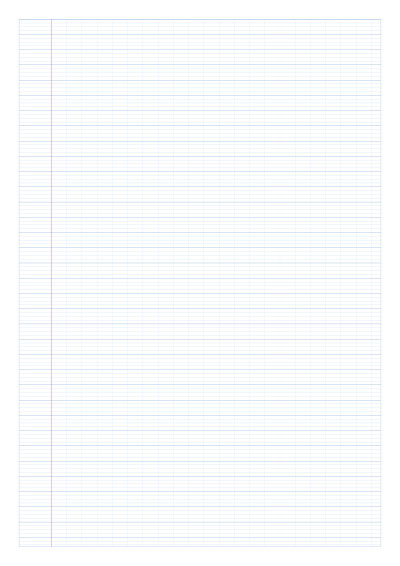
If you have ever seen French school notebooks, you know Séyes ruling. It uses a 8 mm major line with three lighter "guide" lines spaced 2 mm apart between each pair of major lines. This structure trains consistent letter height and spacing. It is mandatory in French primary schools and still widely used in Europe.
PaperMe includes a full Séyes template with authentic blue lines and the traditional red vertical margin at 17 mm from the left edge.
How to Choose Your Line Spacing
Here is a simple decision guide:
- Age under 10 → Wide ruled (8–9 mm).
- Age 10–18 or average handwriting → College ruled (7 mm).
- Small, precise handwriting or professional use → Narrow ruled (6 mm) or Séyes.
- Minimalist journaling, mixed text and sketches → Dot grid (5–7 mm).
- Technical or engineering notes → Grid paper (5 mm squares).
Customizing Line Spacing in PaperMe
Every template in PaperMe lets you override the default line spacing. Use the Line Spacing input in the sidebar and type any value in millimeters. The preview updates instantly. If you are unsure what spacing suits your handwriting, print a single test sheet at 6 mm, 7 mm, and 8 mm and compare.
Try it in PaperMe Studio
Customize your template and download for free - no account needed.